Why ESG is Not Enough
Why ESG is Not Enough
Eileen Flanagan
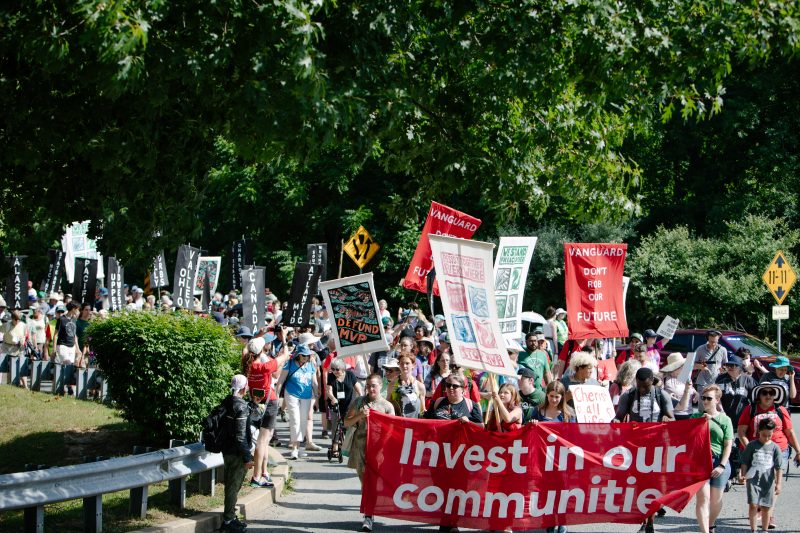
Quakers have a long history of removing our financial support from enterprises that do not align with our values, such as slavery and weapons production. In the last three years, Earth Quaker Action Team (EQAT) supporters have moved $60 million out of Vanguard, the world’s largest investor in fossil fuels. Meanwhile, Quaker Earthcare Witness has begun asking, “What if Quakers left the stock market entirely?” While EQAT and QEW are pursuing different strategies, we agree that mainstream approaches to Environmental, Social, and Governance (ESG) investing are insufficient to allay our moral concerns about financing environmental and climate destruction.
In theory, ESG ratings help investors identify companies that are doing well by doing good. For example, reducing packaging or energy use is both good for the Earth and good for investors since they save the company money. Unfortunately, companies can receive ESG credit for small steps or alternative technologies, obscuring the larger impact of a company’s operations. Exxon has gotten ESG credit for pursuing carbon capture, while continuing to profit from oil extraction. Plans to store the captured carbon are being foisted on communities along the flood-prone Louisiana coast, where locals fear the gases will escape through abandoned drilling rigs.
It’s not just fossil fuels we need to move away from, but the coercive systems that led to our ecological and climate crises in the first place. In Chester, Pennsylvania, residents have long protested a Covanta trash incinerator, whose emissions contribute to high cancer rates in the predominantly Black community. When a Swedish company purchased Covanta a few years ago, it claimed the incinerator business would be good for ESG scores, since incineration is a non-fossil fuel energy source that keeps trash out of landfills. In a classic case of greenwashing, its 2024 sustainability report rebrands the company “Reworld” and features a photo of a Black woman’s hand reaching out to a blue butterfly.
Chilean activists are resisting a greenwashing scheme on the land of the Mapuche people, where some of the world’s oldest trees were felled to make room for monoculture timber plantations that use a dangerous amount of water. The timber company Arauco is getting subsidies to make wood pellets, which count as renewable biomass energy on their ESG score. This is why asset managers like Vanguard need Indigenous rights policies, which would make it harder for such schemes to be passed off as green energy. Instead, Vanguard is one of the world’s largest investors in Arauco and other companies engaging in exploitative and environmentally harmful practices, including Exxon and Reworld’s parent company.
Given the climate movement’s criticisms of greenwashing, many were surprised in 2022 when conservative politicians attacked ESG as “woke capitalism.” Financial commentators described the “woke” trope as “nonsense.” Still, it gained traction, tapping toxic narratives about racial equity and climate action as left-wing plots. In response to this backlash, Vanguard retreated from its only tepid climate commitment and reduced its shareholder engagement, which convinced EQAT that it was time to move our money, a tactic we had delayed to give Vanguard a chance to take more positive steps. In 2026, Vanguard was the only one of three huge asset managers to settle a lawsuit filed by Republican attorneys general, alleging that they were using their power to influence the policies of coal producers.
Ironically, the lawsuit affirms our belief that asset managers could play a role in helping to shift our economy away from fossil fuels, the reason that a coalition of climate groups decided to take on Vanguard in the first place. We don’t just want asset managers to exclude polluting companies from a few of its funds, so we can feel better about our portfolios. We want Vanguard to use its tremendous influence to steer these companies away from climate destruction, which Vanguard itself has acknowledged will be bad for its investors.
EQAT is now making a broader call for Friends to boycott Vanguard and its funds because choosing its relatively few ESG offerings is not enough. To support Friends in finding alternatives, we offer monthly webinars. We also ask people to report their money moving in a confidential method that allows us to feel our collective impact. This is a moral stand, but it’s also a movement that connects us to people struggling for a better world from Chester to Chile and beyond.
The article includes excerpts from Eileen Flanagan’s book Common Ground: How the Crisis of the Earth is Saving Us from Our Illusion of Separation.