Answering the Fire by Sowing SEEDS: Announcing QEW’s New SEEDS Grants Program
Allen J. McGrew
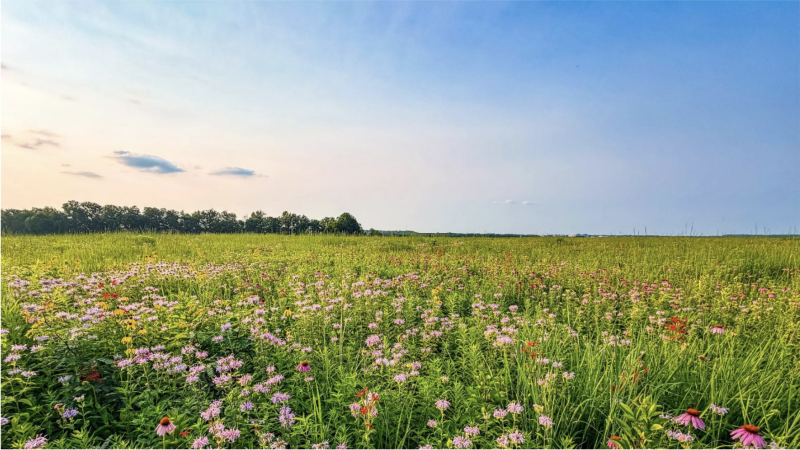
“Hey, Al,” came the call from the other side of the prairie. “Come on over here and give me a hand.” It was my friend Dave Nolin, who, as a young hire at Dayton area Metroparks and an M.S. student at Wright State University, had had a vision of Huffman Prairie restored to its once pristine beauty. Huffman Prairie is best known as the site of the Wright Brothers’ pioneering advances in aviation after their initial flight at Kitty Hawk, but the Wright Brothers had been introduced to it as a botanical gem by Orville’s high school botany teacher.
Unlike many of us, Dave’s vision (like the Wrights before him) did not stop with the dreaming. He did the work.
Now retired (but only in name), Dave put in a lifetime of work leading restoration projects not only at Huffman Prairie, but throughout Ohio’s Miami River Valley. And on this day, while I was out birdwatching, he was calling me to join him in continuing that work, too. Each fall, he invites a community of eager Dayton-area restorationists to collect seed with him from the best-restored areas of the prairie to spread them in adjoining, less densely flowered areas. It was spring now. The prairie had already begun to bounce back from a controlled burn that had left it blackened just a couple months before. Now it was time to cast seed.
Fire does not merely destroy. It can also renew. It can reset ecosystems as part of a natural cycle of rebirth. But we, too, must do our part in that work. In the words of Isaac Pennington, we must “sink down to the seed” and come to understand ourselves as seeds in the vital work of building a community dedicated to renewal.
For the past year, the QEW Mini-Grants program has been working to frame a new vision for our grants programming—one that calls on YOU to participate in the vital work of renewing the Earth. This new grant program is called SEEDS, short for Sustainable and Equitable Earthcare Dreams and Solutions. But SEEDS is more metaphor than acronym: seeds have deep resonance in Judeo-Christian scripture, Quaker faith, and the living testimony of the natural world. Tiny packages of dense wisdom and stored energy protected by robust shells, seeds embody faith, hope, persistence, and endurance through times of great stress, such as fire, winter, or drought.
We live in such times. Earth is burning.
With their tiny size and their down-sinking into soil, seeds also embody humility, silent waiting, and patient confidence in an eventual bursting sunward, rooted in the discovery within the Earth itself of the nutrients and water needed to sustain a season of new growth. Finally, in their small forms, seeds embed the dense instruction necessary to build a sprawling plant, as in the parable of the mustard seed. All these conditions are needed to redeem the human relationship with Earth, and to ground it in healthy mutualistic abundance.
SEEDS is a call not merely to conduct local Earthcare projects, but to leverage the new Quaker Earth Action Map in order to convene an international community of Quakers from all backgrounds and socioeconomic conditions to join in weaving their work together into a global Quaker response to the ever-growing Earthcare crises of climate change and biodiversity collapse. It is a call to Right Relationship – with each other and with the entirety of the living world.
There are many ways that you can participate. SEEDS will need far more than just applicants with wonderful local Earthcare ideas. We will need translators and mentors to help support applications from Frontline communities where Quakers work around the world, from Burundi to Alaska and Bolivia to Indonesia. We will need reviewers for proposals in each of our five main focus areas:
- Re-weaving the Web of Life.
- Fostering Climate Healing.
- Building Healthy and Resilient Communities.
- Education and Outreach for Environmental Transformation.
- Healthy Families and Human Population.
And we will need Right Relationship Partners eager to support each other in sharing wisdom gained in the work.
To learn more about the new SEEDS grant program and how you can apply or otherwise help support it, you should soon be able to find a full description of the program and application guidelines on the Mini-Grants page of the QEW website.